
By the time a prospect contacts sales, they’ve already done most of the work: researched the category, compared vendors, watched competitor videos, and probably asked ChatGPT for a recommendation. In my opinion, it changes everything about how B2B marketing has to be built in 2026. The B2B marketing strategies that worked five years ago, such as TOFU content, MQL volume, and last-click attribution, no longer deliver the same returns.
In this guide, I’m sharing the 20 B2B marketing strategies we’ve personally seen move the pipeline at NEWMEDIA.COM, plus how to measure, budget, and build a marketing engine that drives revenue. Let’s get into it.
What Is B2B Marketing?
B2B marketing is the practice of one business attracting, educating, and converting other businesses into paying customers. Instead of selling to individual consumers, you’re selling to companies, which means dealing with multiple decision-makers, longer sales cycles, and bigger contract values.
For example, a manufacturer of commercial solar panels doesn’t sell to homeowners; they market their systems to logistics companies looking to lower warehouse operating costs.
This type of marketing focuses heavily on building long-term relationships, educating stakeholders, and solving complex operational challenges over an extended buying cycle.
Top B2B Marketing Channels in 2026
There’s no single channel that wins for every B2B business. The right mix depends on your audience, sales cycle, and budget. That said, some channels consistently outperform others in terms of qualified pipeline.
The following matrix outlines the primary distribution channels our B2B marketing agency deploys to maximize corporate visibility and drive qualified demo requests.
How AI Is Changing B2B Marketing?
AI is changing B2B marketing in ways most teams haven’t fully caught up to yet, and the changes go far beyond using ChatGPT to write blog drafts. The biggest shift is on the buyer side. A large portion of early B2B research now happens inside AI tools.
Buyers ask ChatGPT for vendor recommendations and use Perplexity to compare options. If your brand isn’t appearing in those answers, you’re invisible during the most important part of the decision process.
On the production side, AI handles a growing share of operational work. Instead of content teams spending weeks analyzing search metrics, machine learning algorithms can instantly identify shifting buyer intent across the web.
20 Proven B2B Marketing Strategies & Best Practices
1. Build a Revenue-First Marketing Strategy
A lot of teams look at marketing through metrics like impressions and traffic charts, which makes it seem like they don’t care about ROI at all. We build our frameworks around revenue first.
If you spend capital on an initiative, it must bring a qualified pipeline back into your business. Stop greenlighting campaigns that look pretty but fail to generate sales-qualified leads. Focus entirely on commercial outcomes from day one, forcing every asset to justify its existence by how quickly it moves a prospect toward a closed contract.
2. Align Marketing Goals With Sales and Pipeline Targets
Marketing and sales must operate on a unified playbook, or your data becomes completely disjointed. I see too many organizations rewarding marketing for hitting lead volume quotas while the sales team starves for quality.
Match your targets directly with sales pipeline milestones. This means tracking metrics such as email-influenced pipeline and sales-qualified leads rather than raw form fills. The moment your two teams share goals instead of fighting over lead quality, your conversion rates improve, and your sales cycle shortens. It’s that simple.
3. Create Industry-Specific Campaigns for Priority Verticals
Buyers expect you to personalize content specifically to their industry realities, regulatory bottlenecks, and unique operational challenges. If you write a single generic guide trying to please every sector, you’ll please no one, and your message will get ignored. A CFO at a healthcare company doesn’t care about the same things as a VP of Operations at a logistics firm.
Build separate campaigns for your priority verticals: different ad copy, different landing pages, different proof points.
Our B2B clients consistently cut their cost per qualified lead in half just by splitting one generic campaign into three industry-specific ones. It takes more work to set up, but the numbers always justify it.
4. Focus on Commercial Intent Before Traffic Opportunities
Most B2B SEO and content programs chase traffic volume. That’s a mistake. A keyword like “what is project management” gets thousands of searches, but converts almost nobody. A keyword like “Asana alternatives for engineering teams” gets fewer searches but pulls in buyers who are actively evaluating vendors.
These are the specific terms buyers search for when they already understand their problem and are actively evaluating vendors or checking pricing. Capturing ten high-intent executives is worth far more than attracting thousands of random visitors who will never buy your software.
5. Build a Full-Funnel Content Marketing Program
To dominate your market, you can’t rely entirely on a single content type. Implement a balanced B2B content marketing program that guides prospects through every stage of their evaluation journey.
Educational insights capture early awareness, while comparison sheets and case studies provide the validation required during the procurement phase. Organizing your pipeline this way ensures you always deliver the precise data needed to build internal consensus, turning casual readers into invested corporate clients across their entire research journey.
6. Invest in AI Search Visibility and LLM Optimization
If your B2B buyers aren’t already using ChatGPT or Perplexity to research vendors, they will be soon. Your job is to make sure your brand shows up in those LLM answers. Prioritize structuring your technical assets so that artificial intelligence platforms easily extract and cite your data.
Instead of just chasing Google rankings, you must ensure your brand appears natively inside ChatGPT, Perplexity, and Google AI Overviews. This search everywhere optimization approach captures highly qualified decision-makers before they ever visit a traditional search engine results page.
7. Use Account-Based Marketing for High-Value Prospects
Stop treating high-value enterprise accounts like standard website visitors. ABM flips traditional demand generation on its head. Instead of casting a wide net and waiting, you identify the specific companies you want as customers and build entire campaigns around them.
When the CFO and the IT Director receive highly relevant communications simultaneously, you accelerate the deal cycle. For high-value deals, the math is obvious. If a single contract is worth $250,000, spending more to reach the right 50 accounts makes more sense than spending less to reach 50,000 of the wrong ones.
8. Turn Customer Success Stories Into Demand Generation Assets
Most companies publish a customer case study, post it once, and forget about it. That’s a huge waste. A single customer story can fuel months of marketing if you use it properly. Instead of burying case studies on a hidden website page, promote them actively through targeted B2B email marketing sequences to prospects evaluating similar solutions.
Highlight the specific financial impact, implementation timelines, and operational metrics your product delivered. When a prospect sees a competitor achieving measurable results, it immediately builds massive trust and removes the perceived risk of switching vendors.
9. Develop Executive Thought Leadership Programs
People trust people, not logos. Build executive thought leadership programs that function like highly specialized B2B influencer marketing, positioning your leadership team as definitive industry experts.
Having your CEO or technical directors share raw insights about market challenges builds incredible loyalty. This strategy works because it delivers high-value information with zero sales pressure. When executives consistently share valuable perspectives, they capture the attention of other decision-makers.
10. Use First-Party Data to Improve Targeting and Personalization
Relying on basic third-party data is no longer effective. Most B2B companies sit on data nobody else has and barely use any of it. Utilize the behavioral actions collected directly from your B2B web design infrastructure, such as product usage patterns, customer behavior, survey results, and sales call transcripts. To power hyper-relevant campaigns.
If a user spends significant time reviewing a specific integration module, your system must trigger content that is directly related to that technical requirement.
By leveraging your proprietary data, you deliver contextual messaging that answers a prospect’s unstated questions, demonstrating that your brand deeply understands their environment.
11. Create More BOFU Content Than Your Competitors
I’ve said it across many previous guides, and I’ll say it again: investing in bottom-of-funnel content drives the highest ROI. General educational topics bring traffic, but BOFU content brings buyers who already know they need a solution. You must prioritize comparison pages, vendor evaluations, and deep-dive case studies over broad top-of-funnel posts.
When your buyers search for specific procurement answers, your brand must own that conversation. If your competitors only have 5 BOFU pages and you build 50, you’ll own the most important moment in the buyer journey. You’ll have the advantage of capturing executives when they evaluate pricing and seek final confidence before booking a demo.
12. Connect Marketing Reporting to Revenue Outcomes
I’ll say this in every B2B guide I write because it never stops being true. If your marketing reports stop at MQLs and lead volume, you’re going to keep losing budget conversations. Connect every digital touchpoint directly to closed-won revenue.
Track an enterprise lead from their very first download to the final contract signature. This approach reveals which initiatives accelerate sales velocity. Connecting your reporting to revenue lets you stop arguing over unimportant metrics and focus your budget on generating a qualified pipeline.
13. Strengthen Brand Authority Through Digital PR
Getting your brand mentioned in major publications does two things for B2B marketing: it builds trust with buyers who Google your company before signing, and it earns the kind of backlinks that move SEO rankings faster than any link-building campaign ever will.
When decision-makers see your brand constantly referenced by respected third-party platforms, it removes doubt and drastically shortens the sales cycle.
14. Build Multi-Channel Content Distribution Systems
Publishing content on your blog and hoping people find it isn’t a strategy. Your buyers are scattered across LinkedIn, YouTube, Reddit, industry newsletters, and AI search engines. If you’re only distributing in one place, you’re missing most of them.
If a long-form guide performs well, turn it into a YouTube video, extract key data for LinkedIn carousels, and promote it through targeted B2B social media marketing campaigns. You should not depend only on organic search rankings. Repurposing your best assets maximizes your visibility wherever buyers learn and validate solutions, giving your brand multiple chances to generate qualified leads.
15. Use Marketing Automation to Nurture Long Buying Journeys
Complex sales involve long evaluation periods, and you cannot expect a sales representative to manually follow up every week for a year. Use B2B marketing automation to stay top of mind throughout this extended journey.
When a prospect goes silent for a month, the system automatically re-engages them with a highly relevant case study. This consistent delivery of educational value slowly builds trust.
Done right, marketing automation keeps your brand top of mind for a year while sales handles the high-value conversations. Without it, prospects forget you exist between touchpoints.
16. Create Content for Every Stakeholder in the Buying Committee
A B2B deal involves an average of 10 stakeholders. Marketing to just one of them is one of the most common mistakes I see. The person reading your technical documentation is rarely the person signing the final contract. You must build specific assets for every individual involved in the purchasing decision.
A daily software user searches for integration capabilities, while the Chief Financial Officer cares entirely about implementation costs, timelines, and business impact. Structure your campaigns to address these distinct viewpoints simultaneously. When every stakeholder finds content that addresses their specific worry, internal selling becomes easier and deals close faster.
17. Combine SEO, PPC, Email, and Social Into One Growth Strategy
Treating your digital channels as isolated departments destroys your overall return on investment. You must integrate these platforms into a unified system. Take high-performing organic content and turn it into targeted paid advertisements to capture immediate demand.
Next, distribute those same insights through focused email sequences to nurture leads over time. This approach ensures your messaging remains aggressively consistent.
When a prospect sees the same core value proposition across their inbox, search results, and social feeds, it builds undeniable authority and accelerates the procurement cycle.
18. Measure Success by Pipeline Influence
In B2B, the bigger challenge is usually understanding which content influenced the lead. Tracking basic click-through rates tells you nothing about financial impact. Measure success strictly by how campaigns generate a qualified pipeline, as well as content pieces and channels that touched the deals that closed. Most CRMs let you build this view with proper attribution setup.
Evaluating your digital marketing services through multi-touch attribution gives you a clear picture of what drives sales velocity. This data allows you to cut losing campaigns quickly and double your budget on the strategies generating real corporate growth.
19. Build a Consistent Customer Retention and Expansion Program
B2B companies obsess over acquisition and forget that existing customers are the easiest revenue you’ll ever generate. Marketing doesn’t stop at the point of sale. Structure continuous retention campaigns to keep your current clients heavily engaged with your product updates and industry insights.
Monitoring product usage allows you to trigger automated upgrade paths the moment an account approaches its software limits. Building this proactive communication cycle secures high renewal rates and turns your customer base into a massive source of expansion revenue.
20. Continuously Analyze Competitors to Identify New Growth Opportunities
You can’t out-market competitors you’re not paying attention to. Set up systems to monitor what your competitors are doing across every channel: what keywords they’re targeting in Google Ads, what content they’re publishing, what topics their executives are posting about on LinkedIn, what they’re being mentioned for in AI search.
The patterns you’ll spot are gold. A competitor suddenly increasing Google Ads spend on a specific keyword usually means it’s converting for them. Move faster than they do, and you’ll catch opportunities before they become saturated.
How to Measure B2B Marketing: Top KPIs
You can’t improve what you don’t measure properly. You must track the metrics that matter directly to your sales directors. Basic metrics like clicks or page views are meaningless without financial context. At our agency, we judge our campaigns entirely on their pipeline impact.
Here are the core key performance indicators worth your time.
Marketing Influenced Revenue
This is the ultimate indicator of your department’s success. We measure the total dollar value of closed deals that interacted with at least one marketing asset before signing the contract.
By tracking this through multi-touch attribution, leadership can clearly see that a specific technical guide or webinar directly supported a massive enterprise deal, definitively proving your team’s financial value.
Pipeline Velocity
Pipeline velocity measures how quickly a lead moves from their first interaction to a closed-won contract. Analyze this to determine if your nurturing sequences accelerate the buying decision.
If an automated campaign cuts your average corporate sales cycle from six months down to four, your marketing efforts are directly increasing overall corporate efficiency.
Sales-Qualified Lead Conversion Rate
Never celebrate raw lead volume. If you generate a thousand initial downloads but the sales team immediately disqualifies nine hundred of them, your campaigns are failing.
Track the percentage of marketing leads that are officially accepted as sales-qualified. A high conversion rate indicates your targeting is precise and your messaging matches perfectly with the decision-makers in your market.
Customer Acquisition Cost to Lifetime Value
It is easy to buy traffic, but much harder to do so profitably. Monitor the cost to acquire a corporate customer against the total revenue they generate over their entire lifespan.
By understanding this ratio, you ensure your marketing spend remains sustainable and that you are not burning budget just to close low-tier accounts that eventually cancel their contracts.
B2B Marketing Examples
HubSpot’s Content Marketing Flywheel
HubSpot built one of the most successful B2B content engines in the world. Their blog, free tools, certifications, and educational content attract millions of marketers, sales reps, and business owners every month.
The strategy is brilliant in its simplicity; give away genuinely useful content, build trust, and let buyers come to them when they’re ready.
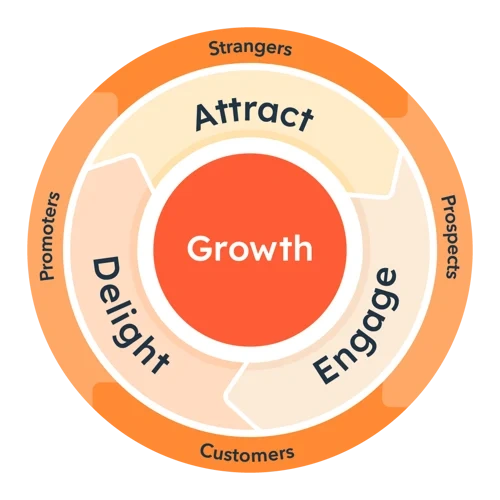
Their entire growth model is based on inbound marketing, and they’ve stuck with it consistently for over 15 years. The result is a company that built a category and dominates the marketing software conversation.
Salesforce’s Trailhead and Community Building
Salesforce realized early that the easiest way to win enterprise B2B deals is to build a community of users who genuinely champion your product. Trailhead- their free, gamified learning platform- turns Salesforce admins and developers into certified evangelists.

When a company evaluates CRM platforms, internal stakeholders who learned on Trailhead consistently push for Salesforce. That community-led growth approach has been one of their strongest competitive moats for over a decade.
Gong’s Proprietary Data and Reality-Based Content
Most software companies publish generic opinion pieces about sales tactics. Gong took a completely different approach by analyzing millions of actual sales calls from their platform to publish proprietary data.

They created a content engine that offered insights no competitor could duplicate, such as the specific word counts that reduce cold email conversions. Their strategy works because publishing original, large-scale research creates a massive competitive moat and builds undeniable authority.
The Cost of B2B Marketing
B2B Marketing Trends & Predictions for 2026
I’m going to be straight with you. The tactics that successfully generated pipeline three years ago are rapidly losing their effectiveness. Buyers demand immediate, highly specific answers, and the technology delivering them is rapidly evolving. If you’re building a marketing plan for 2026, these are the trends to take seriously.
AI Search Visibility Will Become a Core Marketing Channel
Buyers are bypassing traditional search engines to ask complex procurement questions directly to AI platforms. Optimizing for these systems is mandatory for corporate growth. Companies optimizing for AI in B2B marketing search are seeing 2.4x as many qualified leads from organic channels as from traditional search engine optimization strategies.
The brands building AI search visibility now will own category mentions in AI responses for years before competitors catch up. By the end of 2026, optimizing for LLM citations will be as standard as optimizing for Google rankings was in 2015.
Revenue Attribution Will Matter More Than Lead Generation Metrics
Marketing departments no longer survive by reporting basic lead volume or website clicks. Executive boards demand definitive proof of financial impact. They want to know which marketing dollars produced closed revenue.
Multi-touch attribution and CRM-integrated reporting are becoming standard at companies that take marketing seriously. This transition forces marketers to abandon vanity metrics and operate as a direct extension of the sales pipeline, ensuring every dollar spent works to acquire high-value enterprise accounts.
BOFU Content Will Outperform Traditional Traffic-Focused Content
For years, B2B content strategy meant publishing a high volume of top-of-funnel blog posts. That model is breaking. AI Overviews are eating top-funnel traffic, and the buyers who do click through rarely convert.
The brands that want to win in 2026 must shift their content investment toward bottom-funnel pages: comparison content, alternative-to pages, integration pages, pricing breakdowns, and ROI calculators.
When you focus on commercial intent rather than broad search volume, you attract executives with purchasing power, drastically improving the overall quality of your sales-qualified leads.
Executive Personal Branding Will Drive More Trust and Demand
Corporate buyers remain deeply skeptical of faceless corporate messaging. They want to hear directly from the experts building the solutions. Use executive personal branding programs to position founders and technical directors as authoritative industry voices.
When your leadership consistently shares raw, unsponsored insights regarding market challenges, it builds undeniable credibility. This human-centric approach cuts through the noise of automated sales pitches, establishing the authentic trust necessary to secure multi-year corporate agreements.
Search Everywhere Optimization Will Replace Google-Only Strategies
Your buyers aren’t only on Google anymore. They’re searching on LinkedIn, asking ChatGPT, watching YouTube reviews, checking Reddit threads, and using TikTok as a discovery engine. You must plan for visibility across every surface buyers use, not just Google. Content is built for one platform, then distributed and adapted across many others. Search engine optimization is becoming search engine optimization everywhere.
How Do B2B Companies Generate Qualified Leads?
B2B companies generate qualified leads by creating content and campaigns that target specific corporate problems. Instead of chasing broad traffic, they focus on buyers who are actively searching for solutions.
They use search engine optimization (SEO) to appear when executives research vendors, run highly targeted paid ads, and distribute technical case studies via email.
By offering valuable assets such as ROI calculators or technical whitepapers, they encourage decision-makers to share their contact information, turning anonymous visitors into high-intent sales opportunities.
Which Marketing Channel Delivers the Best ROI?
It depends on your business model, but a few channels consistently outperform others for B2B. SEO leads with around 748% ROI over a 3-year window. Email marketing averages 261% ROI, delivering roughly $36 for every $1 spent. LinkedIn delivers 192% ROI on paid social and 229% on organic.
PPC sits at a lower ROAS of around 2x but offers speed and predictability. Most strong B2B programs combine three to five channels rather than relying on a single channel.
What Is Account-Based Marketing (ABM)?
Account-Based Marketing is a strategy where marketing and sales teams work together to target a specific, highly valuable list of corporate accounts. Instead of casting a wide net to attract thousands of individual leads, ABM treats each target company as a market of one.
Identify the key decision-makers within that specific company, such as the CFO, IT Director, and Operations Manager, and deliver hyper-personalized campaigns tailored directly to their unique departmental challenges to win internal consensus faster.
How Long Does It Take to See Results From B2B Marketing?
B2B marketing typically takes three to six months to generate a measurable sales pipeline, though this depends heavily on your current website authority and sales cycle length. Short-term paid advertising campaigns can capture immediate demand within a few weeks.
However, building long-term organic authority and nurturing complex corporate buying committees requires a consistent, multi-quarter commitment. Investing early in a robust strategy ensures your pipeline scales sustainably as your brand authority builds across your industry.
What Are the Most Common B2B Marketing Mistakes?
The most common mistake is measuring metrics such as raw website traffic or lead counts rather than pipeline influence. Many companies also waste budget by automating broken sales processes or sending generic messages that try to please every industry at once.
Other frequent errors include neglecting list hygiene, which destroys your domain reputation, and failing to create specific content for different stakeholders within the corporate buying committee, causing deals to stall during internal procurement reviews.
How Do You Connect Marketing Efforts to Revenue?
Connect your marketing platforms to your CRM, track every lead source through to closed deal, and use multi-touch attribution to see which channels actually influence the pipeline. UTM parameters on every link, GA4 conversion events for key actions, and CRM integration that captures lead source at entry are the foundation.
By mapping every digital touchpoint along the buyer journey to closed-won revenue, you can confidently identify which campaigns accelerate your sales cycle.