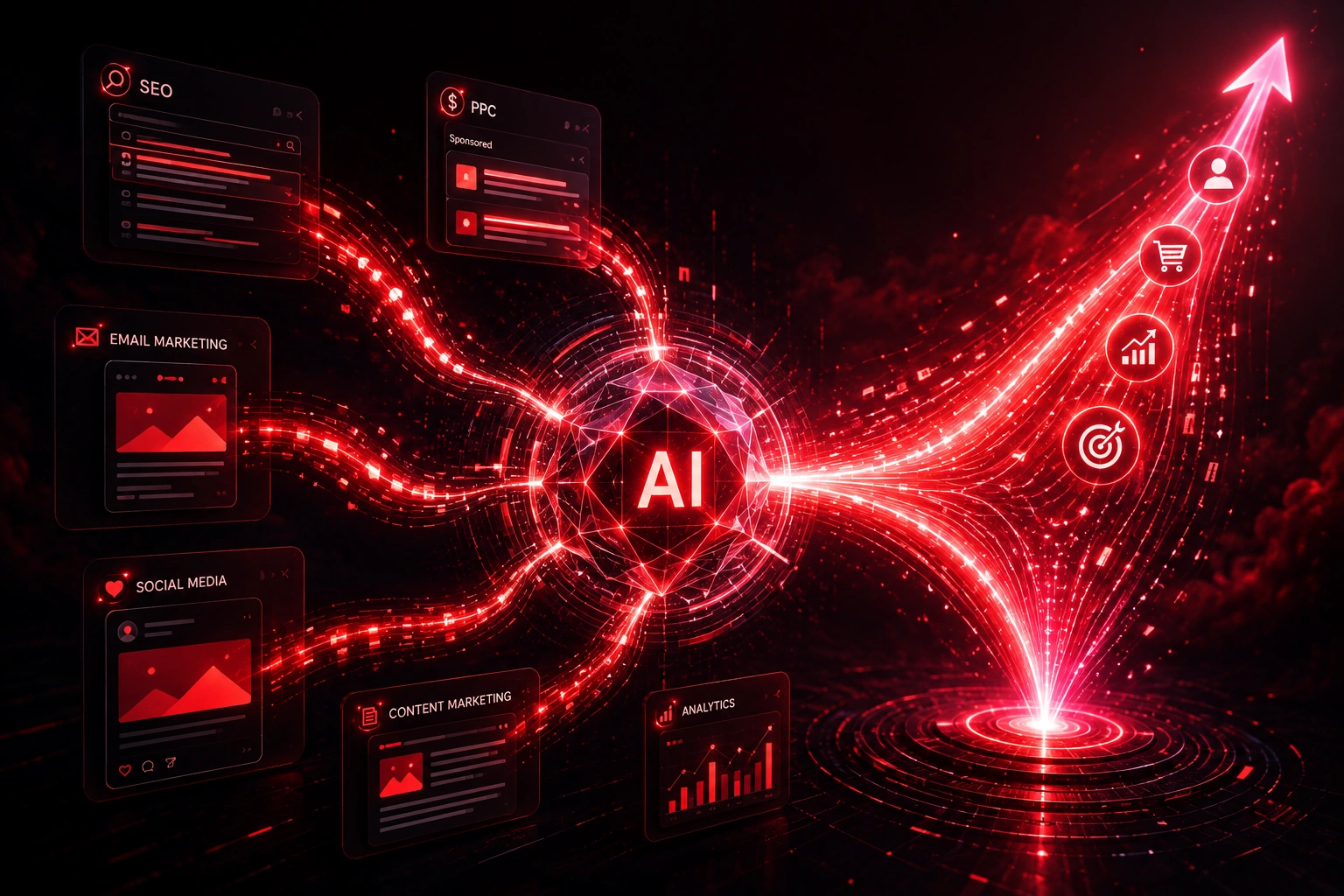
I watched Google Marketing Live 2026 last month and walked away thinking one thing: PPC management, as we know it, is being completely rebuilt around AI. Conversational Discovery ads that create AI agents inside your ad unit. Ask Advisor managing campaigns across Google Ads, Analytics, and Merchant Center through one conversational interface. AI Max is replacing Dynamic Search Ads entirely.
The average CPC on Google Search hit $5.26 in 2025 and keeps climbing. AI-generated ad creatives already boost CTR by 47% and cut CPA by 29%. The question isn’t whether AI belongs in PPC. It’s whether you’re directing it or just accepting whatever the platform decides for you.
In this guide, I’ll outline a step-by-step framework to build an automated pay-per-click strategy, along with discussing how AI is reshaping every part of PPC management in 2026,
What Is AI in PPC Management?
AI in PPC management is the use of machine learning to run paid ad campaigns more efficiently and quickly. Instead of a human manually adjusting bids, writing every ad variation, and analyzing performance spreadsheets, AI systems handle these tasks in real time, processing thousands of data points per second that no human could keep up with.
Here’s a simple example. You run a Google Ads campaign for an accounting firm. Traditionally, you’d set bids manually, check performance daily, and adjust keywords based on weekly reports. With AI, Google’s smart bidding analyzes every single auction- time of day, device, location, user behavior, search history- and sets the optimal bid for each individual click automatically. You set the target, and the AI figures out how to hit it.
How AI Is Changing PPC?
Paid search management has shifted from manual keyword matching and scheduled bidding updates to automated real-time optimization systems. Machine learning models streamline every phase of campaign planning, execution, and budget allocation.
Here’s how it’s showing up across the key areas.
AI for Keyword and Audience Research
Keyword research used to mean spending hours in Google Keyword Planner pulling lists and sorting by volume. AI has compressed that process across every platform.
On Google, tools like Semrush, Ahrefs, and Google’s own AI suggestions cluster keywords by intent, surface competitor openings, and recommend targeting opportunities in minutes. Machine learning models scan search query logs and semantic meaning to identify high-converting clusters before competitors do.
Meta and TikTok skip keywords and build audiences from behavior instead. Meta’s Advantage+ tools pull from pixel data and purchase history to predict who will convert. TikTok leans on watch time, shares, and completion rate to find buyers based on what they engage with, not what they search for.
LinkedIn still lets you target by job title and company size, then layers machine learning on top to expand those lists toward accounts most likely to convert.
Audience modeling tools across every platform build dynamic lookalike segments from first-party data, refining target profiles as trends shift. A PPC agency, still building every campaign around a Google keyword list is missing where most buyers spend their time.
AI for Ad Copy and Creative
Google Marketing Live made creative automation the centerpiece announcement, and for good reason. As I mentioned earlier, AI-generated ad creatives boost CTR by 47% and cut CPA by 29%. That’s mostly because AI enables volume testing at a speed humans can’t match.
More variations tested faster means finding winners sooner and cutting losers before they waste budget. Tools like Google’s built-in asset generation, ChatGPT, Claude, and Jasper now handle what used to take copywriters entire afternoons.
Generate Headlines and Descriptions
Writing 15 headlines and 4 descriptions for a single responsive search ad used to eat an hour of a copywriter’s day. AI tools now produce dozens of variations in minutes. By scanning your landing pages and existing materials, these tools instantly generate relevant headlines and descriptions tailored to your specific offers. They ensure the text matches your brand voice while strictly following brand guidelines.
You no longer need to spend hours staring at a blank screen drafting dozens of manual text variations for different ad groups. This automation allows your marketing team to scale creative production rapidly, launch new campaigns sooner, and keep your messaging fresh without exhausting your internal copywriting resources.
Create and Test Ad Variations
Google Marketing Live 2026 introduced one-click A/B testing for ad assets, testing combinations of headlines and descriptions automatically and surfacing the best performers.
Meta runs the same idea through Dynamic Creative, mixing headlines, images, and calls to action into thousands of combinations and shifting spend toward the best cost per result. TikTok’s Smart Creative testing works off video, swapping hooks and captions mid-campaign based on watch-through rate. LinkedIn’s testing moves slower, built for B2B cycles where a winning ad can take weeks to prove itself.
Across every platform, algorithms monitor engagement and conversion rates in real time, serve the winners, and retire the losers automatically, replacing slow manual A/B cycles with constant adjustment.
Personalize Ads by Audience
The same ad shouldn’t appear for every searcher. A first-time visitor needs a different message than someone who’s visited your pricing page three times. AI makes this level of personalization possible at scale without manually building separate campaigns for every audience segment.
Dynamic creative optimization customizes ad text and visual components to individual user contexts. Machine learning models evaluate user intent signals- such as past site interactions, referral sources, geographical locations, and device types- to alter ad messaging instantaneously.
Integrating dynamic creative engines with a broader marketing framework, often paired with AI SEO strategies to capture organic demand, ensures brand messaging matches consumer expectations across every digital touchpoint.
AI-Powered Bidding and Budget Management
Manual bidding is effectively dead in 2026. Over 80% of Google Ads advertisers use automated bidding. Meta’s Advantage+ campaigns handle budget allocation entirely through AI. LinkedIn’s predictive bidding optimizes toward your conversion goal without manual CPC adjustments. The platforms made this decision for you.
Here’s the thing, though. Automated bidding only works when the conversion data feeding it is accurate. If your tracking is broken (such as counting page views as conversions, missing offline sales, or double-firing tags), the AI optimizes aggressively toward the wrong signal. We’ve audited PPC accounts where smart bidding was spending $20,000 a month optimizing toward junk conversions because nobody verified the tracking setup.
Budget management has shifted, too. Tools like Optmyzr, Shapeshifter, and even Google’s own Ask Advisor now reallocate budgets across campaigns automatically based on real-time performance. If Campaign A is hitting target CPA and Campaign B is overspending, the AI shifts dollars without waiting for a human to check a spreadsheet on Monday morning.
This continuous monitoring prevents wasted spend during slow hours and maximizes campaign budgets when high-value customers are actively searching.
AI for Landing Page Optimization
Getting a user to click an ad is only half the battle. The destination page has to convert that click into a sale, and what triggers the right version depends on where the click came from.
For Google Search traffic, machine learning tools change the headline, images, and text to match the search term someone typed. A search for “enterprise accounting software” lands on a page built around large-scale features. A search for “small business bookkeeping” shifts the same page toward small-team pricing.
Social platforms skip the search term. Meta and TikTok match landing pages to the ad creative someone clicked and the audience segment they fell into, so a video ad aimed at small business owners lands on small business messaging without a word typed. LinkedIn can swap in case studies or pricing tiers based on company size or job title.
Whatever the source, a tight connection between ad and landing page keeps visitors engaged, lowers bounce rates, and increases the chances of a final purchase.
AI for Campaign Optimization
Campaign optimization used to mean checking dashboards weekly, adjusting bids, pausing underperformers, and testing new creatives. AI has compressed that cycle from weekly to continuous.
Rather than waiting for a weekly review to pause a failing ad, intelligent systems monitor campaigns 24 hours a day. The software analyzes which keywords, ad groups, and creative variations are driving the highest return on investment.
When a specific ad combination starts to lose momentum, the system automatically redirects the budget toward the better-performing variations. It also continuously scans the market to uncover new search trends and suggests negative keywords to block irrelevant traffic. By automating these daily micro-adjustments, marketing teams can step back from repetitive data entry and focus entirely on long-term strategy and creative direction.
But bear in mind: “automated” doesn’t mean “unsupervised.” Every platform’s AI optimizes toward whatever goal you set. If that goal is wrong, the AI scales the wrong behavior faster than any human could. Our team reviews automated campaign performance for clients weekly, not monthly. The platforms move fast, so your oversight needs to match that speed.
AI for Conversion Tracking and Attribution
In my decades-old experience, this is the part of PPC that AI has arguably improved the most, and the part most advertisers still haven’t set up properly.
Every major platform now uses AI-powered conversion modeling for tracking. Google’s enhanced conversions use machine learning to recover conversion data lost to cookie restrictions and privacy changes.
Meta’s Conversions API feeds server-side data directly to the algorithm, bypassing browser limitations. LinkedIn’s Revenue Attribution Report traces ad impressions through to CRM-closed revenue. Each platform tracks differently, which is why blending their self-reported numbers produces an exaggerated picture.
A modern digital marketing agency relies on AI for conversion tracking and attribution to solve this problem. Machine learning models trace the entire customer journey, connecting a first click on a social media ad to a final purchase from a paid search ad days later.
These systems use predictive modeling to fill in missing data when privacy blockers prevent direct tracking. Instead of giving all the credit to the final click, the software accurately distributes value across every ad that influenced the buyer.
This clear view of performance ensures we know precisely which channels deliver results, allowing us to invest our budget confidently in the areas that drive the highest return.
How to Build an AI-Powered PPC Workflow
Most teams adopt AI tools without changing their workflow. They bolt automation onto a manual process and wonder why the results are messy. Let me tell you how we built a PPC workflow designed for AI from the ground up.
Define Campaign Goals
You need clear objectives before giving algorithms control over your ad spend. AI systems optimize strictly based on the target metrics you set, whether that means maximizing lead volume, driving online sales, or lowering customer acquisition costs. If you feed an algorithm vague targets, it might generate high traffic that fails to convert into real revenue.
At NEWMEDIA.COM, we start by establishing specific target return on ad spend numbers, target cost per acquisition limits, and daily budget thresholds. Setting these business parameters early ensures the machine learning models make bidding decisions that directly support profitability rather than chasing unimportant clicks.
Prepare Tracking and Data
AI is only as good as the data it learns from. If your conversion tracking is broken, duplicated, or measuring the wrong actions, automated bidding will optimize toward garbage- that, too, confidently and at scale.
Before launching anything, we verify our setup end-to-end. Google Tag Manager is firing correctly. GA4 conversion events match real business actions. CRM integration captures the lead source at entry. Offline conversion imports feed closed-deal data back to Google and Meta. Call tracking attributing phone leads to the right campaigns. Run test conversions through the entire pipeline before spending a dollar.
Setting up solid server-side tracking and enhanced conversions gives the software the reliable context it needs. High-quality input data allows the system to identify the most profitable prospective buyers and optimize ad delivery with confidence.
Select the Right AI Tools
Don’t stack ten tools when three will do. The right AI PPC stack depends on your budget, platforms, and team size.
Rather than adopting every new platform on the market, select specialized tools that integrate directly with our existing advertising accounts. You need to evaluate software based on its ability to handle automated bid management, predictive audience targeting, landing page personalization, and creative generation.
Modern platforms must offer transparent reporting so you can monitor how algorithms allocate ad budgets. Connecting your ad networks with dedicated automated management platforms creates a unified ecosystem where data flows freely, allowing your marketing team to automate routine optimizations while maintaining control over overarching strategy.
Launch with Controlled Automation
Never hand full control to AI on day one. Start with controlled automation, let AI handle bidding and audience expansion while you maintain manual control over creative, negatives, and budget caps.
Run the first 30 days as a learning phase: set conservative budgets, monitor search term reports daily on Google, and check audience breakdowns weekly on Meta and LinkedIn. Monitor where the AI is spending and whether those placements match your ICP.
Once you have 30-50 conversions worth of clean data, loosen the controls gradually. Scale what’s working, and kill what isn’t. The teams that rush full automation before the data is clean always end up paying for it, usually in wasted spend they don’t catch for weeks.
Benefits of AI in PPC Management
AI has improved PPC management and changed what’s possible with the same budget and team size.
Higher Operational Efficiency
AI processes thousands of bid adjustments, audience signals, and creative variations simultaneously, something no human team can match. A campaign running across Google, Meta, and LinkedIn that would take a PPC manager an entire week to optimize manually gets adjusted in real time by AI systems reacting to live auction data.
This shift improves overall productivity while ensuring campaign adjustments happen 24/7, keeping ad spend focused on performance without constant manual oversight.
Improved Campaign Scalability
Scaling ad campaigns across multiple channels often creates operational challenges. AI systems analyze thousands of audience combinations, keywords, and ad assets simultaneously. These automated tools expand campaign reach into profitable new customer segments by predicting search intent and purchasing behavior.
As a result, businesses can increase their ad spend and expand market presence quickly without sacrificing campaign efficiency or overwhelming their internal media buying teams with extra work.
Superior Data-Driven Precision
Machine learning processes complex patterns in user behavior that human eyes miss. Instead of relying on assumptions, automated bidding platforms evaluate contextual signals in real time, including local weather, device type, and browsing history. This level of precision highlights how AI in digital marketing helps campaigns deliver tailored messaging to ideal buyers at the optimal moment, maximizing overall conversion rates and driving a stronger return on investment for the brand.
Risks and Limitations of AI in PPC
Every benefit of AI in PPC has a mirror-image risk attached to it. Speed becomes recklessness without oversight, and automation becomes opacity without monitoring. Here’s what to watch for.
Vulnerability to Poor Input Data
Automated campaigns only perform as well as the data feeding them. If conversion tracking breaks, offline sales logs contain errors, or spam leads flood the CRM, the algorithm will make flawed optimization decisions.
Feeding bad data into an automated system causes the software to pursue low-quality traffic while wasting valuable ad spend. Continuous technical maintenance and tracking audits are necessary to ensure the algorithm receives clean, accurate information.
Lack of Brand Nuance and Context
While AI software writes text rapidly, it lacks a deep understanding of brand voice and cultural context. Automated creative tools can produce generic headlines that fail to connect with prospective buyers.
Without strict human review, AI ad copy might misinterpret product benefits or conflict with brand guidelines. Maintaining a distinct brand identity requires experienced marketers to refine generated text and ensure messaging always matches user expectations.
Over-Reliance on Historical Data
AI models build predictions entirely on past user behavior and historical performance metrics. When sudden market shifts, economic changes, or new consumer trends occur, automated systems struggle to adapt quickly.
If an unexpected event disrupts normal buying habits, algorithms may continue spending money based on outdated patterns. Human oversight is essential to guide strategy, adjust campaign targets, and prevent budget waste during periods of rapid market change.
Will AI Replace PPC Managers?
No, but the role of a PPC manager is undergoing its most radical transformation in the history of paid search. AI has effectively rendered the traditional, tactical media buyer obsolete. If a manager’s daily value relies solely on manual keyword sculpting, bid adjustments, or pulling basic performance reports, those mechanical tasks are now handled faster and more accurately by automated algorithms.
Instead of pulling manual levers inside a dashboard, PPC managers must focus on broader business objectives, such as refining creative direction, analyzing cross-channel attribution, and ensuring the algorithms receive clean, accurate data.
Machine learning models don’t understand your brand’s competitive positioning, nor can they interpret complex market nuances or sudden economic shifts.
Here’s the honest reality: AI will not replace human marketers, but professionals who refuse to use automated tools will quickly lose their jobs to those who embrace them.
The Bottom Line
Artificial Intelligence is now a permanent part of paid advertising. Brands that resist these tools will watch competitors use them to acquire customers more cheaply and quickly.
But treating AI as a set-and-forget solution guarantees wasted spend. The most effective PPC programs pair algorithmic power with strict human oversight. Let the software handle real-time bidding, rapid testing, and budget reallocation.
Keep an experienced team in control of strategy, data quality, and the judgment calls that determine whether automation scales something worth scaling or amplifies a mistake nobody caught.